
Want a copy of your Facebook posts, photos or account history? Facebook’s current tool is called Export your information. You choose the profile, information, dates and format, then download the prepared files.
I originally discovered the usefulness of this because I could not remember my cat’s birthday. I knew Jack was born near the end of September 2013, but every year his pet insurance sent me back to the same question. I was his midwife, after all!
Facebook’s history supplied the answer: 28 September 2013. Thank you, Facebook.
Whether you want to find an old event, keep copies of family photos or review your account activity, an export can be much easier than endlessly scrolling through your timeline.
1Know what you are downloading
A copy to keep
Export selected information to your computer or phone. The original content stays on Facebook.
A useful record
Choose available categories such as posts, account information, connections or advertising activity.
Not a restore button
An export is not a way to restore your whole account or recover content you deleted.
“All available information” does not mean every scrap of information since the day you joined. Facebook keeps different categories for different periods. Your export also excludes content other people shared, such as somebody else’s original photo that you were tagged in.
If you have additional Facebook profiles, export the one you need. Some information, including certain advertising information, is only available through your main profile.
2Find Export your information
Facebook is gradually moving people from Accounts Centre to Meta Account settings. You may see either name.
On a computer
- Click your profile picture at the top right of Facebook.
- Choose Settings & privacy → Settings.
- Open Meta Account or Accounts Centre.
- Choose Your information and permissions.
- Open Export your information. Some versions still use Download your information.
On a phone: open Menu → Settings & privacy → Settings, then open Accounts Centre or Meta Account. Continue through Your information and permissions to the export tool. Use Settings search if the wording has moved.
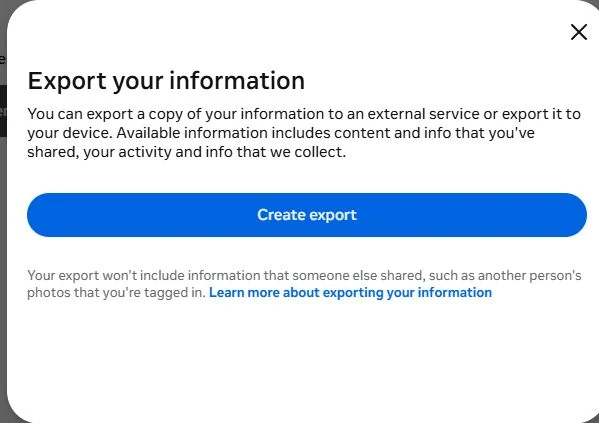
Tap or click the image to enlarge.
3Choose your profile and destination
- Click or tap Create export.
- Choose the correct Facebook profile, rather than an Instagram profile connected to the same account.
- Select Export to device to prepare files you can download yourself.
You may also see Export to external service. That connects another service and offers different export choices. For a copy to keep and browse on your own computer, use Export to device.
4Check the choices before you start
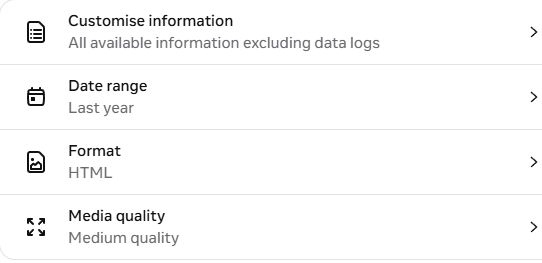
The current screen brings the main settings together. Do not simply accept the defaults: on the account checked for this guide, the date range was Last year.
Tap or click the image to enlarge.
Customise information
Keep the available categories you need, or narrow the selection. For a specific old post, choose the relevant activity rather than requesting a huge collection of unrelated information.
Data logs are a separate optional category. On the current screen they are excluded from the default selection and can take longer to prepare, with a separate download.
Date range
Choose All time for the widest available date range, or choose a specific period. All time still means information Facebook currently has available, not a guarantee of a complete lifetime record.
HTML: for reading
Choose this if you want to browse your history like a website. It is the easiest starting point for most people.
JSON: for working with data
A machine-readable format for software or services that need structured information. Choose it when your intended use requires it.
Media quality: higher-quality photos and videos make larger downloads. Choose the quality that suits your purpose and check you have enough free storage.
Check the notification email address too. You want Facebook’s “ready” message going somewhere you still use.
5Request, wait and download
- Review the profile, destination, selected information, date range, format and quality.
- Choose Start export when you are happy with them.
- Wait for Facebook to prepare the files. The time depends on the request; a large archive will not necessarily be ready straight away.
- Return to Export your information → Available downloads when you receive the notification.
- Download your files and complete any password or verification checks Facebook asks for.
Download promptly. Facebook’s current guidance gives you four days once the export is ready. Follow the expiry shown on your request. If it expires, request another export.
Rather than relying on an email link, you can return to the export tool through Facebook’s settings. If the archive comes in several parts, download each part you need.
6Open the ZIP and find your memories
An HTML export arrives in a ZIP file, which bundles the pages and media together.
On a Windows PC
- Find the downloaded ZIP file, usually in Downloads.
- Right-click it and choose Extract All. Keep the extracted folders together.
- Open the extracted folder and find the HTML file called index, often shown as index.html.
- Open it in your browser and follow the links to the category you want.
On a phone: use the Files or file-manager app to find and extract the ZIP, then open its HTML index. Large archives are usually easier to browse on a computer.
When you reach the page containing your posts, use Ctrl+F on Windows or Command+F on a Mac to search for a word or date. This searches the page you have open, not every file in the archive. You may need to open another category or part.
If you chose JSON, expect data files rather than the same easy-to-browse HTML index.
7What about Messenger messages?
Do not assume a general Facebook export will contain every Messenger conversation. End-to-end encrypted chats have a separate download process.
Facebook’s current guide to downloading encrypted Messenger data says this is available on a computer and depends on having secure storage turned on.
Follow that guide’s route through Privacy and safety → End-to-end encrypted chats → Secure storage → Download secure storage data. Labels can vary. This is separate from choosing Messages in your general Facebook export.
Keep the copy private
Your archive may contain messages, contact details, photos and account activity. Store it somewhere private, particularly on a shared device. Facebook asking for your password to download it does not mean you should assume the extracted files are password-protected.
Before deleting an account or relying on the archive as your only copy of something important, open it and check the files you need are actually there.
For related settings, see Tighten your Facebook Security and How to Change the Adverts You See on Facebook.
Next in the series: How to Control Your Facebook News Feed.
Sources and update notes
Updated 17 October 2026. The desktop export setup and its default options were checked in Facebook. Facebook’s current Help pages were checked for download expiry, file formats, available information and encrypted Messenger exports. Screenshots show desktop; mobile app steps were not tested directly. Menus and labels can vary as Meta Account settings roll out.
← Back to 20 useful things to make you a Facebook super-user
Digitally Done, giving you back a little bit of control!