
Your Facebook account does not sort itself out when you die. You can plan ahead by choosing a legacy contact to look after your memorialised profile, or asking Facebook to delete your account after your death.
“Happy birthday, Fred. Have a wonderful day!” Usually a lovely message. Rather awkward when Fred died three years ago.
Most of us have seen it. Facebook friends who have lost touch, birthday reminders, and a profile carrying on as though nothing has happened. A little planning now can spare your family some of that later.
Here is how Facebook’s current options work, what a legacy contact can actually do, and where to find the settings on a computer or phone.
1Choose what you want to happen
Memorialise your profile
Your main profile becomes a place for people to remember you. Choose a legacy contact in advance to manage the parts Facebook allows.
Delete after death
Tell Facebook you want your account permanently removed once it is notified of your death. Make sure loved ones know this is your preference.
Choosing a preference now does not memorialise or delete your account today. Facebook still needs to be told when someone has died. Do not confuse “Delete after death” with ordinary account deletion or deactivation.
If you make no arrangement, someone can still request memorialisation with the appropriate evidence. Without a legacy contact, the memorialised profile cannot normally be managed or updated.
2Understand memorialisation
A memorialised profile displays Remembering beside the person’s name. Existing photos and posts remain visible to the audience they were shared with. Depending on the settings, friends may be able to share memories.
Memorialised profiles stop appearing in birthday reminders, People you may know suggestions and adverts. Nobody can log in to the account, including the legacy contact.
Planning ahead comes first
You choose your own legacy contact while you are alive. Their management role starts after Facebook memorialises your profile. Requesting memorialisation for somebody who has already died is a separate process, covered below.
3Find the current settings
Facebook is gradually moving people from Accounts Centre to Meta Account settings. Both versions are in use, so your menu may differ from somebody else’s.
On a computer: use Settings search
- Click your profile picture at the top right of Facebook.
- Choose Settings & privacy → Settings.
- In the settings search box, type memorialisation. Try memorialization if your Facebook uses American spelling.
- Open Memorialisation, then choose your Facebook profile if asked.
In the Meta Account layout checked for this guide, the setting is also under Manage account → Manage beside your Facebook profile → Memorialisation.

Tap or click the image to enlarge.
If you still have Accounts Centre
Facebook’s current Help route is Settings → Accounts Centre → Profiles and personal details → Account ownership and control → Memorialisation. Select your Facebook account to continue. Some versions shorten the label to Personal details.
On a phone: open Menu → Settings & privacy → Settings. Use Settings search for “memorialisation”, if available, or follow the Accounts Centre route above. Menu position and wording vary between iPhone, Android and account versions. The screenshots here show desktop settings.
4Choose your legacy contact
Choose somebody you trust, and talk to them first. It is a responsibility, not a surprise gift! Facebook currently requires you to be 18 or over to select a contact, and the person must be one of your Facebook friends.
- Open your Facebook Memorialisation settings.
- Choose Memorialise account, then Next, if those choices appear. If you already have a contact, open their entry to review or change it.
- Search for your chosen friend and select the correct person.
- Decide whether to give them data archive permission. Read the explanation before choosing.
- Save your choice. Facebook may then offer Send to notify them, or Skip if you do not want to send the notification.
This applies to your main Facebook profile, not additional Facebook profiles. You can return to change your contact. Read the options carefully before removing one: Facebook’s current instructions use Delete after death when removing a contact without choosing a replacement.
5Know what you are allowing
They can
- Pin a post and update your profile and cover pictures.
- Manage available tribute and tagging options.
- Respond to new friend requests, if appointed before your death.
- Request account removal.
They cannot
- Log in as you.
- Read your private messages.
- Make new friend requests or remove your existing friends.
- Rewrite your past posts.
A detail worth knowing: Facebook says a legacy contact can view posts even if their audience was set to Only me. Choose the person with that in mind.
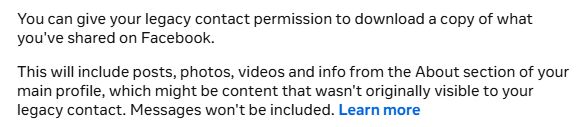
Archive permission is separate. If you allow it, they can download posts, photos, videos and information from the About section of your main profile. That archive may include content they could not previously see. Private messages are excluded.
Tap or click the image to enlarge.
6Prefer your account to be deleted?
In Memorialisation, look for Delete after death or delete your profile after death. Read the confirmation before saving that preference.
This is a permanent removal choice for after Facebook learns of your death. It is not a temporary break from Facebook. Save important pictures elsewhere now, and tell your family what you have chosen so they know what to expect.
7When somebody has already died
Use your own Facebook account and the official Help routes below. Facebook does not give relatives the person’s login details.
To request memorialisation
Start with Facebook’s guidance for reporting a deceased person, then follow its memorialisation request link. Have the person’s profile link and evidence of their death ready; provide the information requested by the current form.
To request removal
Use Facebook’s deceased-account removal guidance. Facebook asks for documentation confirming an immediate family member or executor. Its guidance lists a death certificate, or alternative proof of authority and proof of death. Follow the current requirements and cover unrelated personal details on documents.
If you are the appointed legacy contact, open the memorialised profile from your own account and look for Manage. The controls available depend on the profile and when you were appointed. Facebook reviews requests; there is no processing time I can promise you.
One more thing if you run a business
A legacy contact is not a replacement for another trusted Page administrator. If you are the only person managing a business Page, arrange suitable access while you can. Memorialising your personal profile does not automatically hand the business over.
Not the cheeriest item on the to-do list, admittedly. But a few minutes now can leave your family with clear wishes instead of another thing to untangle.
Next, take a look at Tighten your Facebook Security.
Sources and update notes
Updated 17 October 2026. The Meta Account desktop settings and current Facebook Help were checked for this guide. Facebook is rolling out new account settings, so labels and routes vary. Phone directions follow the available settings structure; the mobile apps were not tested directly.
← Back to 20 useful things to make you a Facebook super-user
Digitally Done, giving you back a little bit of control!